

One of the major challenges facing fact-checking newsrooms is identifying the claims that deserve investigation in the first place. With misleading statements scattered across social media, podcasts, television and radio, journalists cannot possibly monitor everything. NORDIS has during the last two years been testing how AI-assisted monitoring can help address this challenge.
For fact-checkers, verifying a claim is only part of the job. Before journalists can investigate whether a statement is true, misleading or false, they first need to discover it.
This has become increasingly difficult as public debate takes place across a growing number of digital platforms, some of which are difficult to monitor systematically. Even traditional, lengthy political debates in parliaments and discussions on television and radio programmes generate hours of content containing potentially checkable statements.
NORDIS has for the last couple of years been testing and using technology developed by Norwegian company Factiverse to explore how automated monitoring can support editorial research and help journalists identify claims they might otherwise miss.
The technology uses artificial intelligence to analyse audio, video and other content, identify factual claims and provide preliminary assessments and relevant sources for further investigation. The findings are subsequently presented to journalists, who can use them as a starting point for independently assessing and verifying the identified claims.
From automated monitoring to published journalism
The potential of this approach is illustrated by an example in which the identification of a claim contributed directly to a published fact-check.
On 9 January 2026, the Danish radio station Radio IIII broadcast an episode of the debate programme “Ta’r jeg fejl?” (Am I Wrong?), discussing gender equality in the workplace.
During the programme, a commentator and author claimed that companies with women in leadership positions perform worse than average. He referred to financial data from the international investment research company MSCI to support his argument.
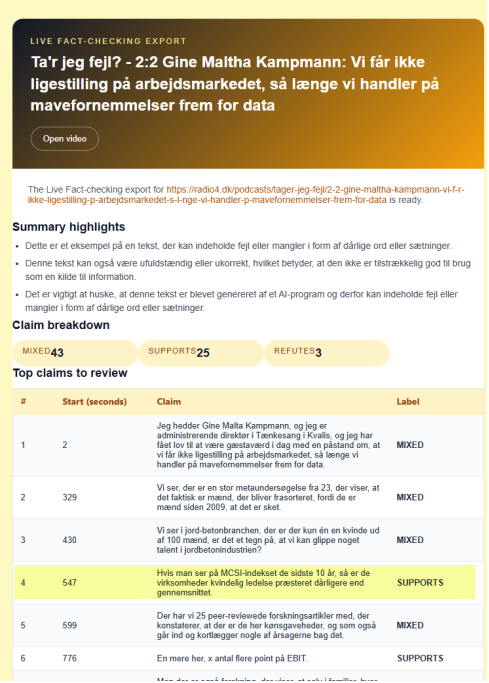
FIGURE 1: Extract from the Factiverse monitoring report generated on 9 January 2026. The system identified a claim about companies with women in leadership positions during a Danish radio debate. The statement subsequently became the subject of a published TjekDet fact-check.
The programme was among those monitored by Factiverse on behalf of NORDIS partner TjekDet.
Factiverse automatically identified the statement and included it in a report delivered to the newsroom, together with other factual claims detected during the broadcast. The report included timestamps, extracted statements and preliminary automated assessments.
The claim subsequently became the subject of an independent journalistic investigation.
TjekDet’s journalists examined the underlying financial data and consulted academic experts about research into the relationship between gender diversity in corporate leadership and company performance.
Their investigation found that the data presented did not establish that companies perform worse because they have women in leadership positions. Research findings were mixed, and the financial comparison cited in the debate did not demonstrate a causal relationship.
TjekDet was then able to publish the fact-check: “Do companies with women in leadership positions perform worse than average?“

FIGURE 2: Screenshot of TjekDet’s fact-check published on 19 January 2026, examining the claim originally identified through Factiverse’s automated monitoring. The investigation found no evidence that female leadership itself causes companies to perform worse than average.
The example illustrates how automated monitoring can contribute to the earliest stage of the fact-checking process by identifying a potentially important claim and bringing it to the attention of journalists.
It also highlights the distinction between automated claim detection and independent journalistic verification. AI-generated assessments may themselves be inaccurate or lack context. The responsibility for investigating the claim, evaluating evidence and reaching a conclusion remains with the journalists.
Monitoring beyond individual broadcasts
The experience with Factiverse extends beyond this single example.
NORDIS partners has tested the technology in for example a live editorial setting ahead of the European Parliament elections in 2024. Several journalists followed a televised Danish election debate while Factiverse simultaneously analysed the broadcast.
The experiment showed that the system could identify factual claims within approximately 10–30 seconds of their appearance. However, while claim identification worked well, the system initially struggled to distinguish between statements of greater and lesser editorial relevance. Factiverse subsequently has worked on improving this aspect of the technology.
NORDIS partner TjekDet also tested the system during the Danish Parliament’s annual opening debates. Such political debates can last for many hours and involve numerous speeches and exchanges in which factual claims may be made. For fact-checking newsrooms, systematically monitoring these events can be both time-consuming and resource-intensive, as it traditionally requires journalists to follow lengthy discussions closely in order to identify potentially checkable statements. Automated monitoring tools can help address this challenge by identifying and highlighting factual claims throughout the debate, allowing journalists to focus their attention on assessing and investigating relevant statements rather than having to monitor the entire event manually.
TjekDet has now been using the system for more than a year as part of the ongoing editorial research. The newsroom receives regular reports identifying statements that may warrant further investigation.
Technology as an editorial assistant
TjekDet’s experience illustrates both the opportunities and limitations of AI-assisted monitoring.
Automated systems can help newsrooms monitor a broader range of content, identify potentially misleading claims that might otherwise go unnoticed and, importantly, significantly reduce the time between a claim being made and its identification by journalists.
Speed is particularly important in fact-checking journalism. Research has highlighted how fact-checks often struggle to reach audiences while misleading narratives are still circulating and attracting public attention. A 2026 study published in Political Communication found that, during the 2022 US midterm elections, the first fact-check of a misinformation narrative was typically published four days after the narrative initially appeared. By then, approximately 77 per cent of the related social media posts had already been shared.
This illustrates a fundamental challenge for fact-checking organisations even a thoroughly researched fact-check may have limited opportunities to reach its intended audience if it is published after public attention has moved elsewhere.
By identifying factual claims at an earlier stage, automated monitoring can potentially enable journalists to begin their investigations sooner, respond more efficiently to emerging misinformation and publish their findings while the claims are still part of an active public debate.
However, speed must never come at the expense of journalistic accuracy and credibility. A rushed fact-check based on incomplete evidence, insufficient verification or misleading automated assessments risks undermining the very trust that fact-checking journalism seeks to strengthen.
The challenge is therefore not simply to produce fact-checks faster, but to make the process leading up to publication more efficient without compromising editorial standards.
Identifying a factual statement does not necessarily mean that it is false, misleading or newsworthy. Determining which claims deserve attention, evaluating the available evidence and reaching well-founded conclusions must remain the responsibility of professional journalists.
For the NORDIS partners, the purpose of using Factiverse has therefore not been to replace journalists or automate editorial conclusions, but to strengthen the research process that precedes fact-checking – helping the newsroom identify relevant claims earlier, allocate its resources more effectively and respond to misinformation while it still matters to the public debate.